


By Jodi Enda
Kelly Whitehead might not be a rabbi were it not for Donald Trump. Then again, she might not be a rabbi at Temple Micah were it not for my daughter and me. Not that I’m equating us.
Yet here she is, Micah’s newest rabbi, delivering poignant sermons that incorporate her deep understanding of Jewish history and teachings, her inherent humor and humanity, and the occasional assist from her researcher, “Rabbi Google.” She comes equipped with years of social justice work and advocacy and an eagerness to meet with individual congregants in the hope that she can help make their lives more meaningful and their Judaism more relevant.
As we talk in a DC coffee shop, Rabbi Whitehead expresses her profound joy at her new job as Micah’s rabbinic fellow, her respect for the other rabbis and the staff, her appreciation for the temple’s practices of questioning and innovating—and her new office chair, which arrived this very August day.
“I can show you a picture!” she says exuberantly. “Oh yeah, and Adam Zemel and I found a desk on the street in Georgetown!” (Yes, her close friend is the son of Micah’s rabbi emeritus.)
“I just feel so grateful to be in this job,” Rabbi Whitehead says. “Even if the days are really long, it’s undeniably fulfilling.” She says she feels as if she’s in a “pinch-myself kind of situation—to be in what really felt like a dream job, a social-justice motivated, intellectually curious, musically profound, dynamic congregation that values innovation and doesn’t care about wealth as a reflection of the classist world outside.”
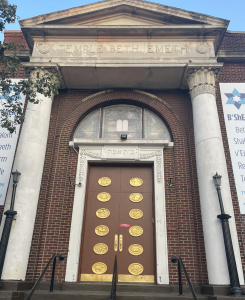
Rabbi Whitehead’s grandfather, Donald Katz, carved the plaques on the doors at B’ShERT: Beth Shalom v’Emeth Reform Temple
For most of her 32 years, Rabbi Whitehead neither expected to be a rabbi nor, once she entered rabbinical school, a pulpit rabbi.
“I wasn’t one of the people who had my bat mitzvah as my dress rehearsal for being a rabbi. I didn’t always see myself down that path because probably I didn’t see people like me in that role,” says Rabbi Whitehead, whose mother is the Jewish daughter of a Holocaust survivor and whose late father was West Indian.
Rabbi Whitehead’s maternal grandfather, artist Donald Katz, decreed that a young Kelly and her brother, Ethan, should grow up in a synagogue. After a bit of shul shopping, their mother, Emily Whitehead, found “the place” in Brooklyn. The next day, Emily phoned her dad, who revealed that years earlier he had carved the plaques on the temple’s massive wooden doors, their 10-foot panels containing golden symbols of the twelve tribes of Jacob.
“I am someone who believes we often find ourselves exactly where we are meant to be and that sometimes, what we call coincidence is just the universe nudging us,” Rabbi Whitehead wrote in an email earlier this year, when the temple of her youth was honoring Emily for decades of volunteer work. Both her children and Emily became b’nai mitzvah at Temple Beth Emet (now Beth Shalom v’Emeth Reform Temple).
Kelly further solidified her Jewish identity as a camper and then as a counselor at URJ Camp Harlam, where, at age 18, she helped supervise a bunk that included my daughter, Ilana. When I picked Ilana up in 2012, she told me that her counselor was about to start college at American University and that we had to hire her as a babysitter. (Ilana, now 25, is sitting in on our interview.) Rabbi Whitehead picks up the story:
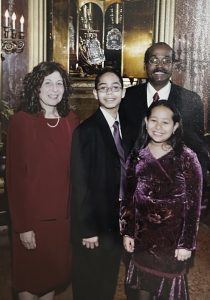
A young Kelly Whitehead with her mother Emily, brother Ethan, and father George at B’ShERT
“I remember you connected me to Danny (Zemel), and he wanted to meet me. And I remember going to his office, and I was like, ‘What do you wear?’ So I put on a blazer and nice pants, which is hilarious” because Rabbi Zemel is partial to hoodies. “I was kind of nervous because it was an interview to teach in the Machon. And I must have been sitting properly, speaking formally or something. He’s like, ‘There’s no need to be so formal.’”
Needless to say, she got the job. After graduating from AU, she continued to work with young Jews, accepting a position as a youth engagement specialist at Temple Sinai. The year was 2016.
Then came the election of Donald Trump.
“I remember the clergy at Sinai just really holding the grief of folks in those following months,” Rabbi Whitehead recalls. When the new administration imposed a Muslim ban, Temple Sinai’s rabbis went to the airport to protest, she says. “I remember feeling so motivated by the clergy in a way I wasn’t by local politicians. And I learned that it’s because of something called their moral voice.”
The rabbis, she says, linked their actions and opinions to thousands of years of Jewish traditions and texts, which enabled them “to make sense of that very chaotic time in the world.”
The future Rabbi Whitehead was uplifted by Sinai’s rabbis and by the outward actions of the Reform movement, which voted at the URJ’s 2017 Biennial conference to pursue racial justice and an end to systemic racism within Judaism and in the larger American community. She also felt empowered by a URJ JewV’Nation Fellowship, a leadership development program centered on affinity groups. Meeting other Jews of Color helped her to realize she was not alone.
At the same time, she struggled with contradictions within the walls of Temple Sinai, where some members questioned whether she was Jewish or even confused her for a custodian. She thought about the two mixed-race children she had been babysitting, whose family attended Sinai. “And I was like, they cannot have this. That is not fair to them,” she says. “I felt inspired.”
With a push from one of Sinai’s rabbis, she applied to Hebrew Union College-Jewish Institute of Religion and started her year in Israel shortly before the pandemic closed down in-person gatherings. She returned to Micah as a Tisch Fellow in the summer of 2023, the same year she got a master’s degree in nonprofit management and another in Hebrew literature from HUC-JIR.
Her summer at Micah—and the mentorship of Rabbi Daniel G. Zemel—made Rabbi Whitehead reconsider her reluctance to serve as a congregational rabbi. But that would take some time. Following her ordination in 2024, she and her then-partner, also a rabbi, moved to North Carolina. Rabbi Whitehead worked for two years as an assistant director for the URJ, where she taught people “on the margins of Judaism,” some because they were new to the teachings, some because they lived in areas with no synagogues. She designed and led adult learning initiatives on themes that included antisemitism, LGBTQ+ inclusion, and peoplehood.
Now, the self-described perfectionist is embracing the culture at Micah, a place that she says is allowing her to stretch her muscles, intellectually and spiritually.
Her early sermons provide vivid glimpses into her intellectual heft, her desire to challenge dogma and tradition, and her ability and willingness to provoke and make us question our assumptions about ourselves and the world around us. Here’s one example from a sermon to mark Shabbat Nachamu, the Shabbat of Comfort, which follows Tisha B’Av, the saddest day on the Jewish calendar:
When fear becomes our primary way of seeing, our own pain can crowd out everything else. We become experts at recognizing betrayal and slower to recognize solidarity. It’s easier to think of every moment we stood alone and overlook the moments when others stood beside us. Our expectations begin to shrink and we become more cautious about extending trust, even when partnership might be possible.
Trauma shapes our memories, our present, and….. our imagination. It becomes harder to picture a future that is not organized around survival. Harder to imagine relationships rooted in mutual care rather than mutual suspicion.
On a more personal level, Rabbi Whitehead is meeting one-on-one with Micah members and asking them why they are Micah members—and more.
“I think we’re in a time where religion, Judaism, is incredibly optional, if anything, challenging. And we’re located in a place where there’s choice,” she says. “People are actively choosing Micah. And so I’m learning why they’re choosing Micah and also why they’re choosing Judaism at this time.”
Rabbi Whitehead remains connected to Camp Harlam, where she met not only my daughter and Adam Zemel, but her girlfriend, Hannah Lafargue. She wants to use what she’s learned, in rabbinical school and in life, to help congregants deal with their challenges and their passions. She wants to engage people on the issues of the day, including Israel-Palestine and antisemitism. She wants to become involved with social justice on such topics as immigration and trans rights.
Mostly, she says, she wants to immerse herself in Micah, to exchange ideas with her colleagues and congregants, to advance the spirit of experimentation, and to extend the joy of the Jewish journey that drew her to the temple in the first place.
“It’s really nice,” she says, “to be in a community where people care.”
This article originally appeared in the Sep/Oct/Nov 2026 issue of the Vine.